A feasibility workspace where every zoning rule traces back to its document
TerraScope AI takes a residential site from uploaded zoning documents to a costed feasibility report. Rules are pulled from the PDFs and checked by a person. The verified rules then drive the design brief, the concept options and the cost estimate.
In short
TerraScope AI is a property feasibility platform I built to replace manual zoning review and spreadsheet costing. Zoning certificates, title deeds and stand schedules are extracted chunk by chunk, and a person verifies or rejects each result. Verified constraints feed a design brief, several scored concepts and a deterministic cost estimate in rand, with ranges and confidence shown.
- Stack
- Next.js, FastAPI, Supabase
- Extraction
- RAG with per-chunk review
- Concept scoring
- 5 criteria
- Costing
- Deterministic, in ZAR
01 / The problem
Why the AI property feasibility platform was needed
A feasibility study usually starts with someone reading zoning schemes, title documents and stand schedules by hand. They copy height limits, coverage and setbacks into a spreadsheet, sketch what might fit on the site and price it from experience.
Each of those steps loses the link to the document that justified it. When a reviewer asks where a number came from, the answer depends on someone remembering which page of which PDF they read. The platform needed to keep that link intact from the first upload to the final report.
02 / The build
How I approached the build
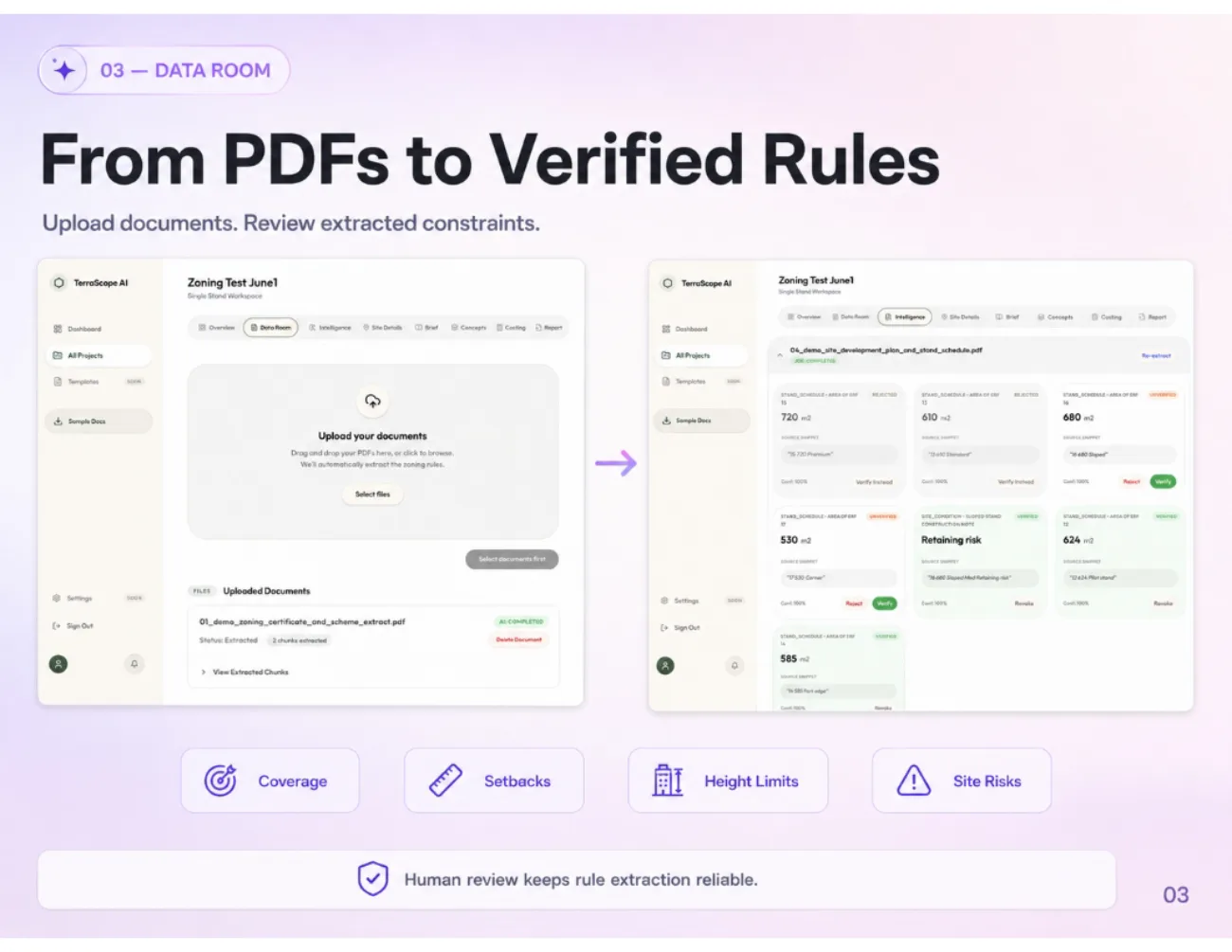
I built the frontend in Next.js and TypeScript, with a FastAPI backend and Supabase for data. The workspace is a sequence of tabs: data room, intelligence, site details, brief, concepts, costing and report. Uploaded documents go through a RAG pipeline that extracts content per chunk, and each chunk gets an explicit verify or reject decision. Nothing reaches the site model just because the extractor was confident.
Zoning, coverage, height, setbacks and floor area ratio are stored with the source snippet and a confidence score. Stand schedules are parsed into structured rows with their snippets attached, so a scanned table becomes data the rest of the pipeline can compute with. The concept engine produces several options and scores each on privacy, views, buildability, cost efficiency and compliance confidence.
Costing is calculated, not generated. Base area, a rate per square metre and risk multipliers produce a range in rand with a confidence percentage and an element breakdown. When an input such as the budget cap is missing, the estimate lists it as a missing assumption. AI explains the result, but it never guesses the maths.
03 / Capabilities
What the AI property feasibility platform does
Reviewed document extraction
Zoning certificates and title deeds are extracted per chunk, and each chunk is verified or rejected by a person.
Constraints with sources
Every rule shows the snippet it came from and a confidence score.
Stand schedule parsing
Scanned stand schedules become structured rows the pipeline can calculate against.
Constraint-aware brief
Rooms, finishes and priorities are captured next to the verified site and stand data.
Scored design concepts
Several concepts are generated and scored on five criteria, so the trade-offs stay visible.
Deterministic costing
Cost ranges in rand come from area, rates and risk multipliers, with missing inputs listed.
Traceable feasibility report
The report is built from verified extraction, the chosen concept and the costing.
04 / Workflow
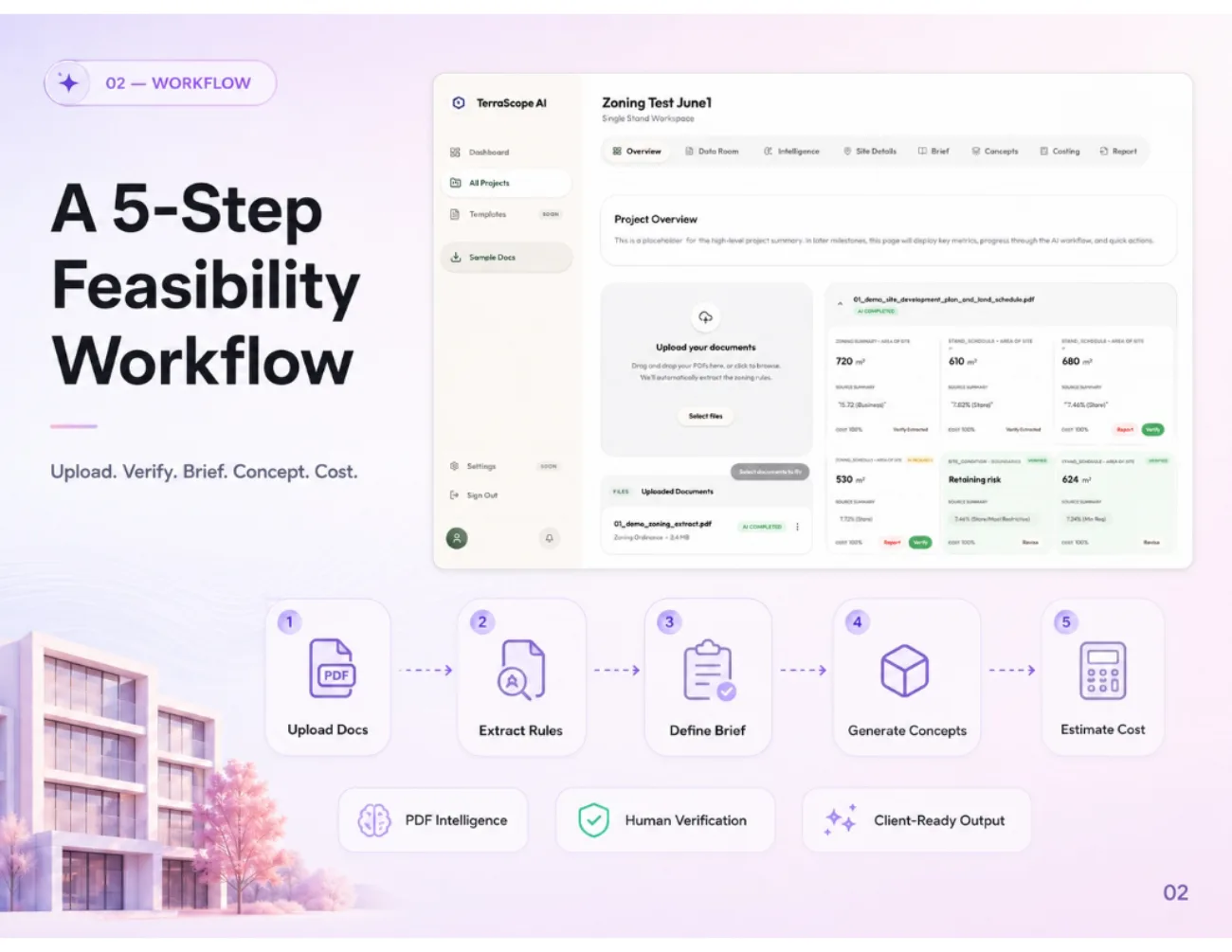
How it works, step by step
- 01
Upload site documents
Add zoning certificates, title deeds and stand schedules to the data room.
- 02
Verify extracted rules
Review each extracted chunk and accept or reject the constraints it contains.
- 03
Define the brief and concepts
Capture the room programme and preferences, then generate and compare scored concepts.
- 04
Cost and report
Run the deterministic estimate and export the feasibility report.
05 / Product screens
Product screens
Select a screen to inspect the interface, workflow and operational details more closely.
Data room extraction
06 / What changed
The practical result
- Every constraint in the workspace links back to the document snippet it was drawn from.
- Concept options carry scores on five criteria, so the trade-off between them is explicit.
- Cost estimates show a range, a confidence percentage and any missing inputs instead of one confident number.
Common questions
Questions about building a similar AI property feasibility platform
It turns site documents into a costed development option. In TerraScope AI, zoning rules are extracted from uploaded PDFs, checked by a person, and then used to shape a design brief, several scored concepts and a cost estimate. The final feasibility report keeps a link from each constraint back to the document that set it.
It can extract them, but a person should confirm them before they are used. Here each document is processed chunk by chunk, and every chunk gets a verify or reject decision. Height limits, coverage, setbacks and floor area ratio are shown with the source snippet and a confidence score, so the reviewer can check them quickly.
Yes. Stand schedules are extracted into structured rows, with the original snippet attached to each one. That turns a scanned table into data the brief, concepts and costing steps can calculate against, while still letting a reviewer see exactly which part of the document each stand area came from.
Because a guessed construction cost is worse than no cost at all. The estimate is calculated from base area, a rate per square metre and risk multipliers, then shown as a range in rand with a confidence percentage. AI can explain the result, but the numbers come from a fixed formula that gives the same answer every time.
The estimate says so directly. If the brief has no budget cap or there is no local contractor rate source, those gaps are listed as missing inputs and assumptions on the cost card. The platform does not fill them in quietly, so the reader knows how much weight the estimate can carry.
Each concept is scored on the same five criteria: privacy, view quality, buildability, cost efficiency and compliance confidence. Generating several scored options, instead of one answer, makes the trade-offs visible. A concept that responds well to a slope or keeps the best views can be weighed against one that is cheaper to build.
Work with me
Building a PropTech or document-heavy planning tool?
I build full-stack platforms that pull structured data from complex documents, keep humans in the review loop and calculate results you can trace.
Discuss your projectKeep exploring
Related case studies
PropTrader AVM | AI Property Intelligence Platform
An AI property valuation platform with automated valuation, portfolio tracking, market context, scenario simulation and appraisal reports.
Read the AI property valuation platform case studyAutomationDocument AI | Payroll Onboarding Automation
An AI document processing system that reads onboarding scans, cross-checks each field and fills a 54-column payroll template, with 98% of fields automated.
Read the AI document processing system case studyAutomationAmpere Support | RAG Chatbot with Live Human Handoff
A RAG customer support chatbot with an embeddable widget, WebSocket chat, automatic escalation and live agent handoff.
Read the RAG support chatbot case study