SEO research, content production and publishing in one workflow
This platform helps a content team manage research, generation, translation and publishing across several websites. It replaces a chain of isolated tools with a structured workflow that keeps content data and deployment steps consistent.
In short
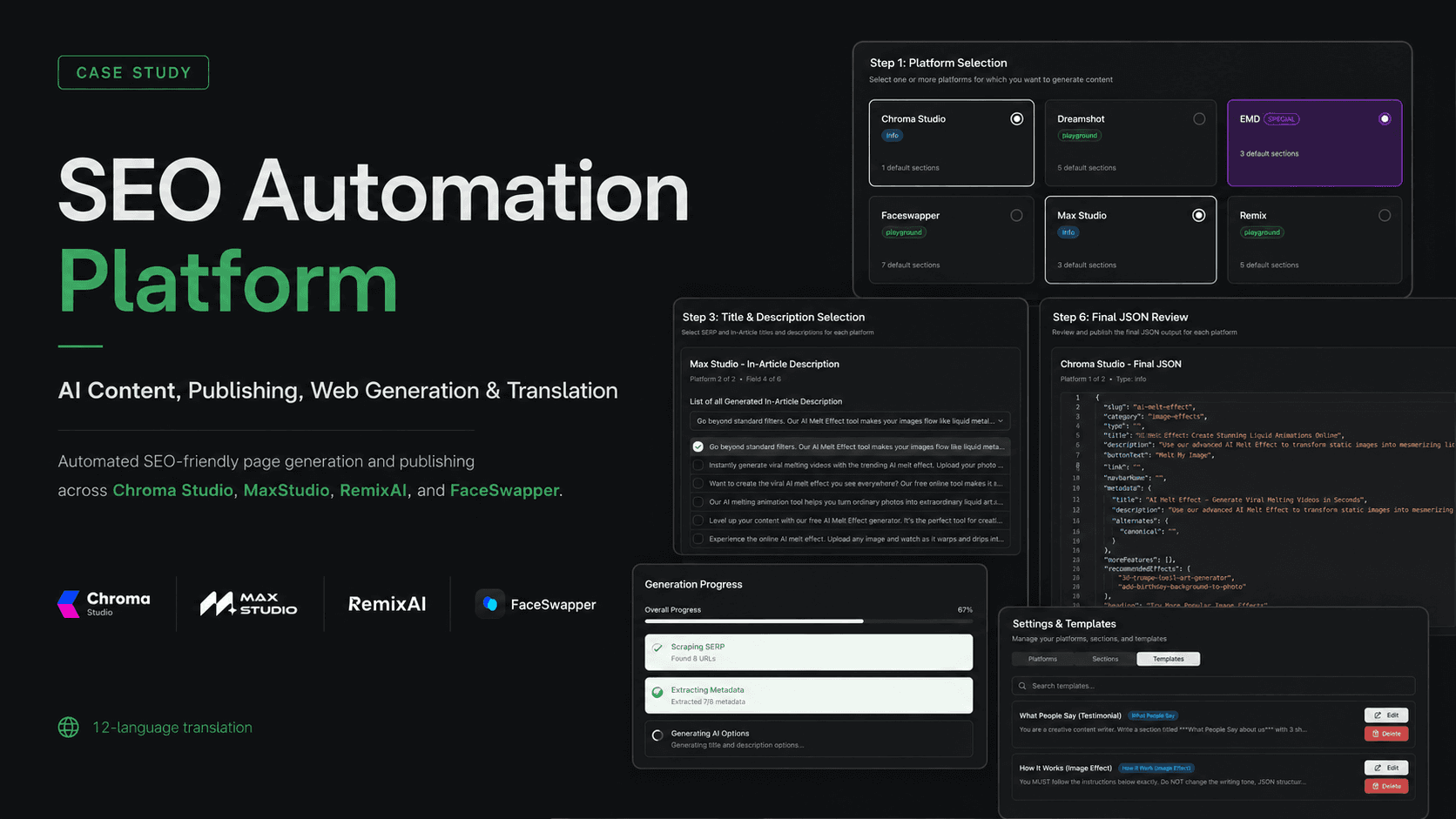
This SEO automation platform helps a content team research, generate, translate and publish content across several websites from one workflow. LangChain and LangGraph coordinate AI-assisted generation against a defined content schema, and content is stored as structured data synced with GitHub. Domain management and site generation sit in the same system, so each site keeps its own content and deployment context.
- Workflow stages
- Research, generation, translation, publishing
- AI stack
- Vertex AI, LangChain, LangGraph
- Publishing
- GitHub synchronization
- Automation services
- Python
01 / The problem
Why the SEO content automation platform was needed
High-volume content operations often accumulate separate spreadsheets, prompt documents, translation tools, repositories and deployment steps. Each handoff creates another place for formatting, metadata or publishing errors.
The platform needed to increase output without turning every site into a copy of the same template or publishing unreviewed model output.
02 / The build
How I approached the build
I built a workflow for content research, structured AI-assisted generation, translation and publishing. LangChain and LangGraph coordinate the processing steps, while Python services handle automation and integration work.
Content is stored as structured data, synchronized with GitHub and published through platform-specific website workflows. Domain management and site generation are part of the same operating system.
03 / Capabilities
What the SEO content automation platform does
Research workflow
Topics and source material are organized before content generation begins.
Structured generation
Outputs follow a defined content schema instead of returning an unstructured block of text.
Translation pipeline
Localized content can move through the same controlled workflow.
GitHub synchronization
Approved content and site changes can be committed to the publishing source.
Multi-site operations
The team can manage separate site workflows without repeating every manual step.
Website generation
Structured content feeds deployment-ready website output.
04 / Workflow
How it works, step by step
- 01
Research the topic
Collect search intent, source material and the required page structure.
- 02
Generate structured content
Run the content through defined AI and validation stages.
- 03
Review and synchronize
Approved output moves into the relevant repository and site workflow.
- 04
Publish and maintain
Deployment and domain operations stay connected to the content record.
05 / Product screens
Product screens
Select a screen to inspect the interface, workflow and operational details more closely.
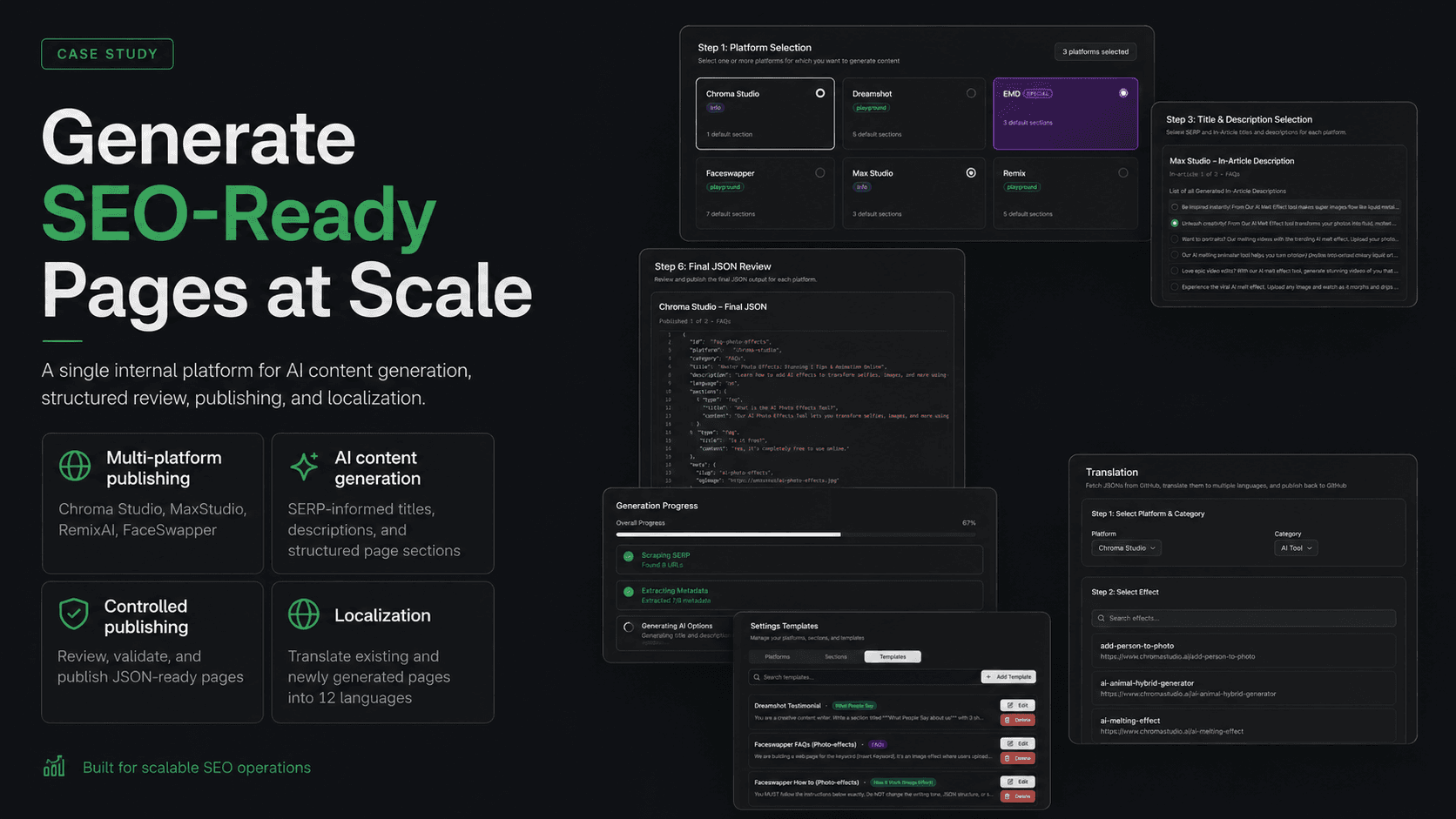
SEO Automation Platform | AI Content & Publishing product view 1
06 / What changed
The practical result
- Research, content data and publishing steps now move through one visible workflow.
- Structured output reduces formatting work when content reaches the website layer.
- The platform can support multiple sites while retaining separate content and deployment contexts.
Common questions
Questions about building a similar SEO content automation platform
Typical systems connect research, briefs, structured content, review, localization, repository updates and publishing while keeping quality controls visible.
Automation itself is not the goal. The content still needs original value, accurate information, clear ownership and a useful experience for the intended reader.
Yes. A multi-site platform can share workflow infrastructure while keeping each site's content, brand and deployment rules separate.
No. It structures research, drafts and publishing tasks, but approval remains a visible stage before content reaches a live site.
Yes. Structured fields and validation keep titles, metadata, sections and internal references consistent before repository synchronization.
Approved content is converted into the format expected by the target repository, synchronized and then passed to the existing deployment process.
Work with me
Need an SEO automation developer?
I build publishing systems that reduce repetitive production work while keeping content structure, review and deployment under control.
Discuss your projectKeep exploring
Related case studies
Imagen | AI Media Generation Platform
An AI media generation platform for image, video, prompt and document workflows, with async job queues, realtime progress updates and reusable templates.
Read the AI media generation platform case studyWebLinkTap | Social Link Analytics SaaS
A social media link analytics SaaS for trackable URLs, traffic collection, campaign attribution and performance dashboards.
Read the link analytics dashboard case studyAutomationCustomer Feedback Analyzer | n8n AI Routing & Team Alerts
An n8n customer review automation that classifies feedback, stores records, routes team alerts and supports email follow-up.
Read the n8n customer feedback workflow case study