One operations platform for a 3PL's seller, support and warehouse teams
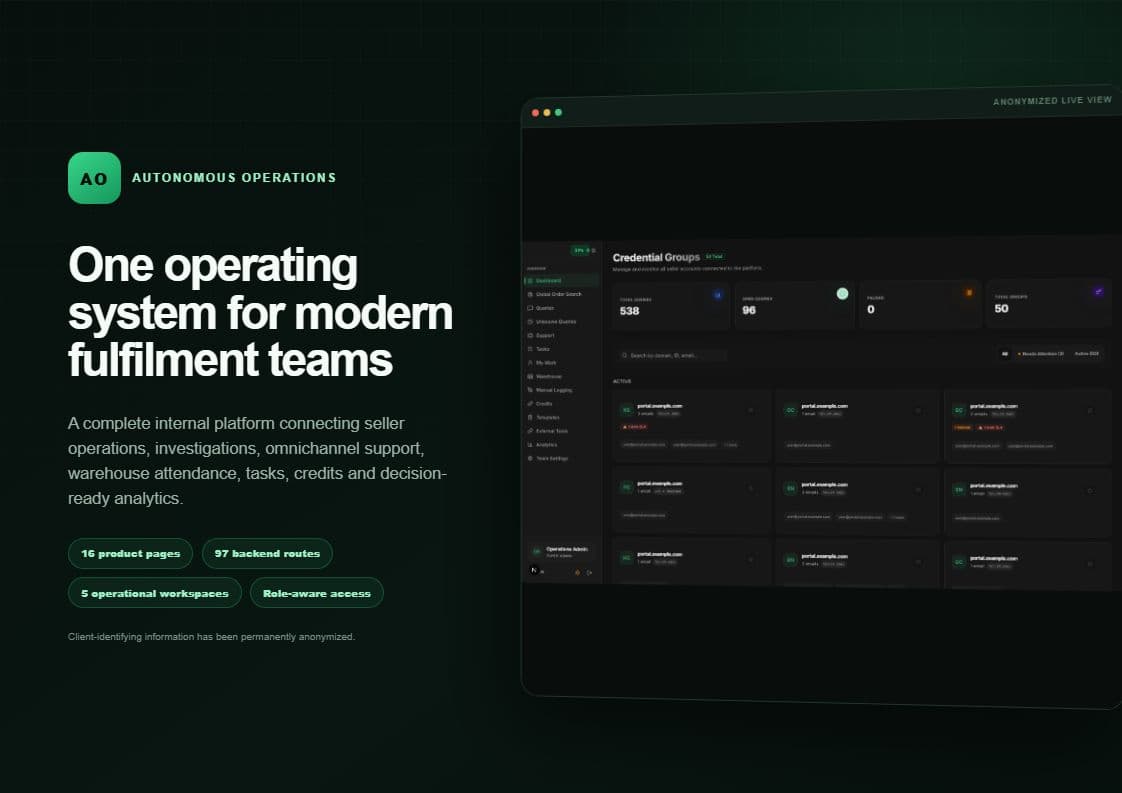
Support Space is an internal operations platform for a high-volume fulfilment business. It gives support agents, warehouse managers and administrators one place to handle seller accounts, order investigations, customer conversations, credits, tasks, attendance and reporting.
In short
Support Space is an internal operations platform for a high-volume 3PL fulfilment business. Support agents, warehouse managers and administrators use it to handle seller accounts, order investigations, customer conversations, credits, tasks, attendance and reporting in one place. It connects Gmail, Freshdesk and ChannelDock data, keeps AI-assisted replies under human review, and gives seller, support and warehouse teams one shared operational model.
- Product pages
- 16
- Backend routes
- 97
- Operational workspaces
- 5
- Integrations
- Gmail, Freshdesk, ChannelDock
01 / The problem
Why the 3PL operations platform was needed
The operations team worked across seller records, carrier updates, support inboxes, order tools and warehouse processes. Staff needed to move between systems before they could understand a case or take action.
The difficult part was not building another dashboard. The platform had to preserve ownership, status history and financial context while keeping common actions fast for operators who use it throughout the day.
02 / The build
How I approached the build
I built a role-aware Next.js operations interface backed by Firebase. Server-side workflows connect Gmail, Freshdesk and ChannelDock data with internal records for sellers, investigations, tasks, credits and warehouse activity.
The platform contains 16 product pages, 97 backend routes and five operational workspaces. Important actions remain reviewable, and AI-assisted replies stay under human control before anything is sent.
03 / Capabilities
What the 3PL operations platform does
Seller command center
Account health, workload, connected identities and investigations are visible at seller level.
Global order search
Operators can locate an order without knowing which seller owns it before they begin.
Support workspace
Conversation history, attachments, order context and operational actions stay inside one ticket view.
AI-assisted replies
Drafts use ticket and knowledge context, with a human review step before sending.
Credits and audit history
Financial adjustments, ownership and linked references remain inspectable.
Warehouse control
Attendance, breaks, live activity, corrections and kiosk actions share one workflow.
04 / Workflow
How it works, step by step
- 01
Find the operating context
Search the seller, order, shipment or conversation from a shared entry point.
- 02
Surface the exception
Show the current status, evidence, ownership and next valid actions.
- 03
Complete the work
Reply, assign, register a credit, update a task or resolve a warehouse action.
- 04
Retain the history
Keep the decision, references and operator activity available for later review.
05 / Product screens
Product screens
Select a screen to inspect the interface, workflow and operational details more closely.
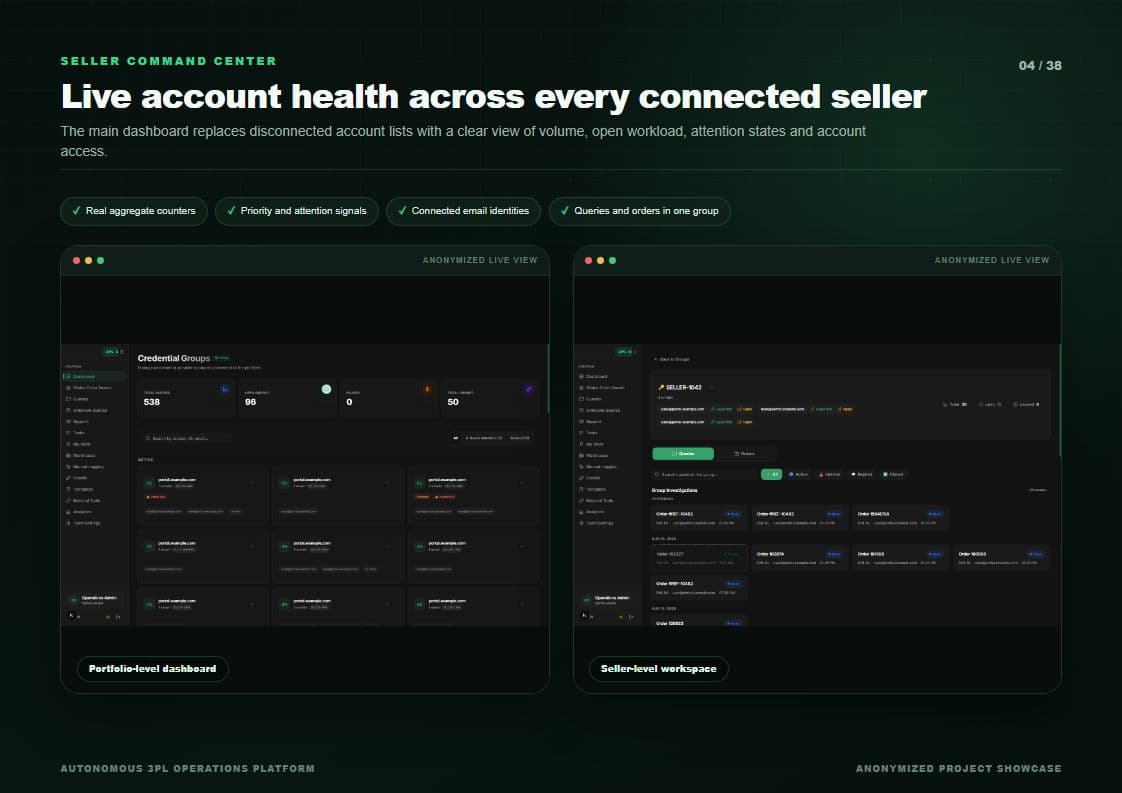
Seller command center
06 / What changed
The practical result
- Seller, support and warehouse workflows now share one operational model instead of behaving like unrelated tools.
- Operators can work from the relevant order and conversation context without rebuilding that context for every action.
- Managers have searchable records and exports for operational review without slowing down the live workspaces.
Common questions
Questions about building a similar 3PL operations platform
Common targets include seller onboarding, order lookup, carrier investigations, support routing, document handling, credits, warehouse attendance, task assignment and operational reporting.
Yes. This project connects existing services such as Gmail, Freshdesk and ChannelDock while keeping the internal workflow and audit history in one application.
It should not remove review from sensitive actions. Support Space uses automation to prepare context and reduce repetitive work while operators keep control of replies, credits and case decisions.
Each workspace and sensitive action is restricted by role, with permission checks enforced by the backend rather than only hidden in the interface.
Yes. Shared seller, order and case references connect the teams while separate workspaces keep each role focused on its own responsibilities.
Indexed search fields, cursor pagination and separate aggregate records keep live workspaces responsive without losing access to older history.
Work with me
Need a logistics automation developer?
I build internal tools and automation for fulfilment teams that have outgrown spreadsheets, inbox rules and disconnected dashboards.
Discuss your projectKeep exploring
Related case studies
3PL Email Automation | Carrier Investigations & Seller Portal
3PL email automation for carrier investigations: sellers raise evidence-backed cases, the carrier email is sent automatically and replies land on the case.
Read the 3PL email automation case studyEnterpriseAI Returns Scanner | Label Reading & Returns Intake
An AI returns scanner for a Dutch 3PL. Workers photograph the label, Gemini reads it, and the return is matched and booked in ChannelDock.
Read the AI returns scanner case studyEnterpriseShift Board | Carrier Cutoff & SLA Planning
A live 3PL cutoff planning board: pick backlog vs carrier cutoffs, picker deficit advice, order forecasts and per-carrier SLA emails sent exactly once.
Read the warehouse cutoff planning board case study