A multi-agent system that takes a niche idea to a live website
AutogeniX is a website generation system built from specialised AI agents. Each agent owns one stage, from requirements and design to validation and deployment. The result is a complete, deployed site with its own look, not a single page that still needs a developer.
In short
AutogeniX is an automated website generation system I built with a team of specialised Python agents. It turns a niche idea into a complete Next.js or HTML/CSS site, checks the design for originality, fixes failures inside the stage where they happen, then pushes to a repository and deploys. It has generated more than 50 websites, each with a distinct brand identity.
- Sites generated
- 50+
- Agent stages
- 8
- Output
- Next.js or HTML/CSS
- Delivery
- Repo push and live deploy
01 / The problem
Why the automated website generation system was needed
Asking a model to produce a website in one pass tends to give a generic layout, broken links to images or files, and no route to production. Someone still has to review the code, fix errors, source assets and deploy it. That follow-up is most of the actual work.
The goal was to launch many niche sites quickly. That added a second problem: if every site came from the same prompt, they would all look like one template with different text.
02 / The build
How I approached the build
I split the job across specialised agents, written in Python, each responsible for one stage: requirements, design intent, blueprint, implementation, validation, review, assets and deployment. When a stage fails, the system sends a targeted fix to that stage instead of restarting the whole run. This keeps long generations on track and avoids paying twice for work that already passed.
Each site gets its own palette, typography and layout plan. A design check then scores the result for originality and forces a regeneration when it looks repetitive. The output can be Next.js or plain HTML and CSS, and the final agent packages the project, pushes it to a repository and deploys it, returning a live URL.
03 / Capabilities
What the automated website generation system does
Stage-owned agents
Requirements, design, blueprint, build, validation, review, assets and deployment each have a dedicated agent.
Targeted repair
A failure is fixed inside the stage where it happened rather than by restarting the run.
Originality gate
Generated designs are checked for repetition and regenerated if they look like a template.
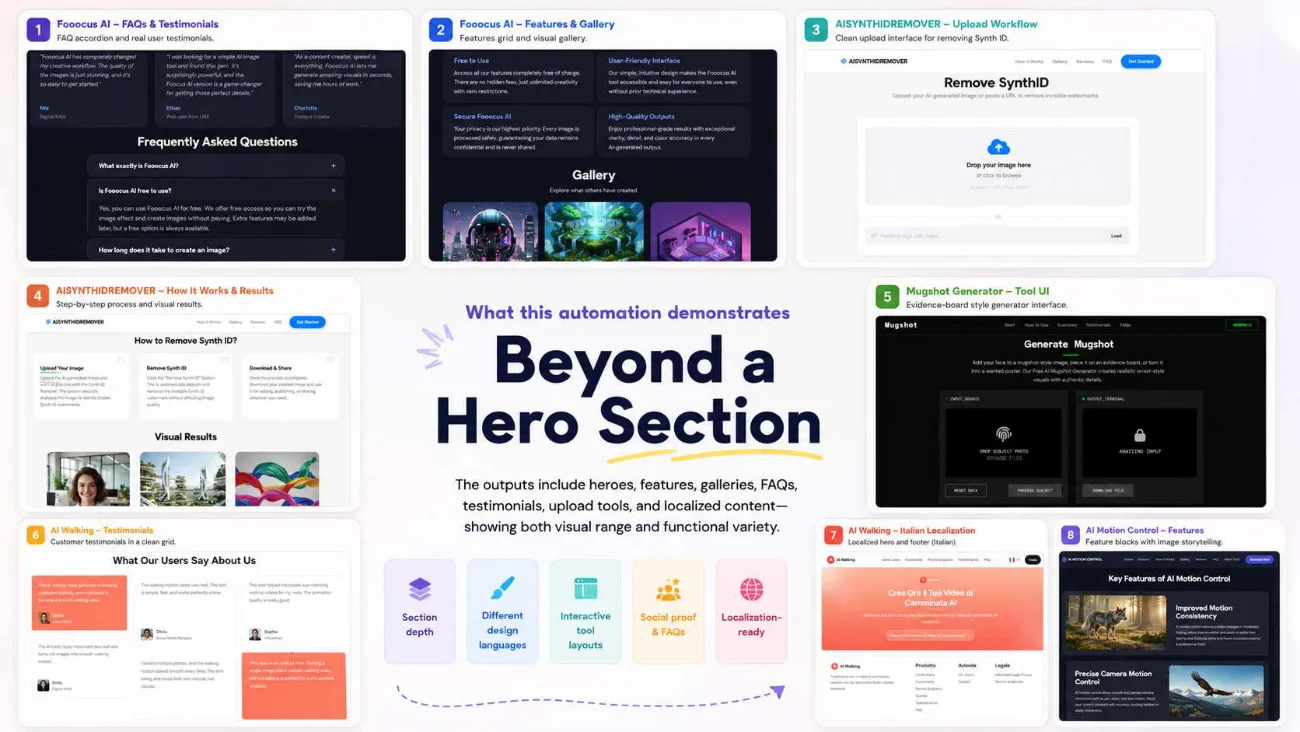
Full page sections
Sites include heroes, feature grids, galleries, FAQs, testimonials and how-it-works steps.
Interactive tool layouts
Pages can include working upload flows, so the site is a product page with a task, not a brochure.
Localised variants
Sites can ship in more than one language, such as an Italian hero and footer.
Repository and hosting deploy
The finished project is pushed to a repository and deployed to a live URL.
04 / Workflow
How it works, step by step
- 01
Capture the niche
Requirements and design intent are set for the product or idea.
- 02
Plan the brand and blueprint
Palette, typography, layout and page sections are planned per site.
- 03
Build and check
Code is generated, validated and reviewed, with failed stages repaired in place.
- 04
Deploy
Assets are added, the project is pushed to a repository and a live URL is returned.
05 / Product screens
Product screens
Select a screen to inspect the interface, workflow and operational details more closely.
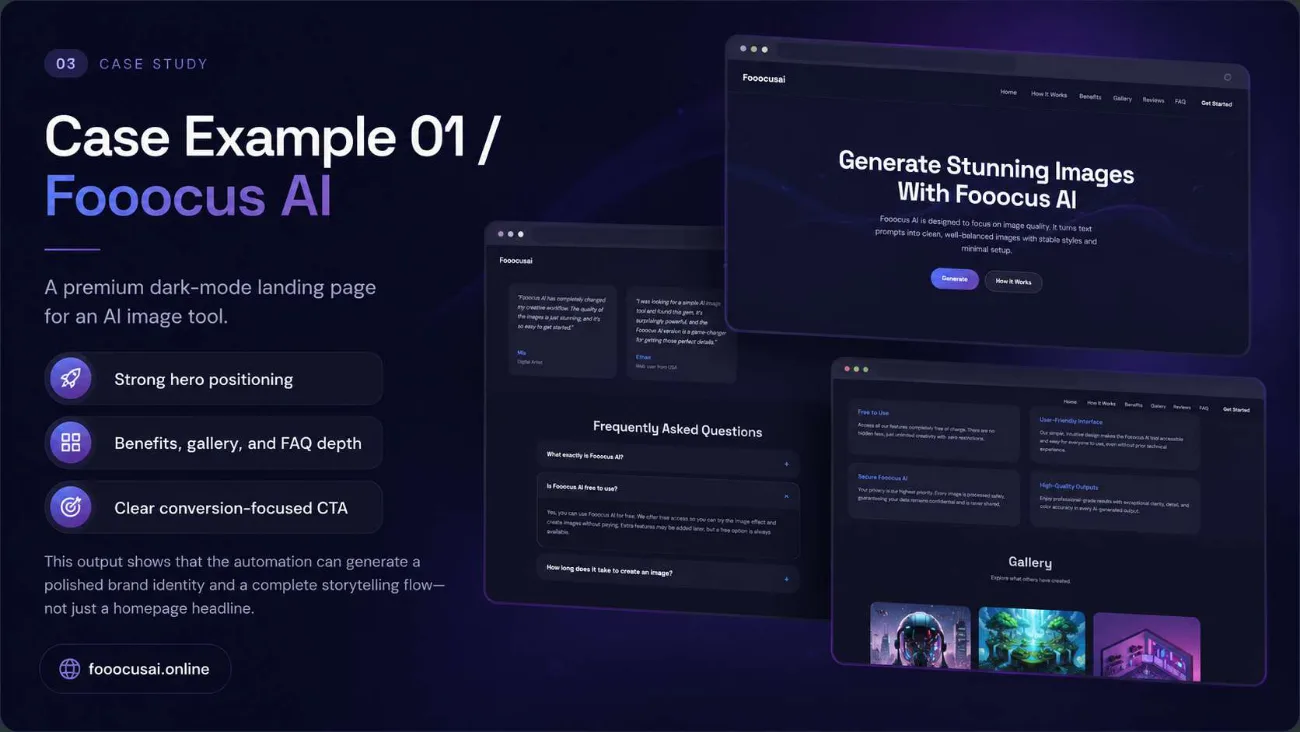
Dark-mode AI image tool site
06 / What changed
The practical result
- More than 50 websites generated by the same system.
- The 5 sample outputs use clearly different design languages, from a dark premium landing page to a neon motion product site.
- Several sample outputs are live domains, deployed by the pipeline itself.
Common questions
Questions about building a similar automated website generation system
It is software that produces complete, deployable websites from a short brief with little manual work. AutogeniX uses separate AI agents for requirements, design, blueprint, build, validation, review, assets and deployment. The output is a working Next.js or HTML/CSS project pushed to a repository and hosted, not a mockup or a single hero section.
By testing for sameness and rejecting it. Each site gets its own palette, typography and layout strategy, then a design check scores the result for originality. If it reads as repetitive, the system regenerates it. That check is why the sample outputs range from a clean utility site to a neon, high-energy product page.
Only the failing stage is repaired. Because each stage belongs to its own agent, a broken reference or a validation error triggers a targeted fix for that part of the run. The rest of the work is kept, so a long generation does not start over every time one step goes wrong.
Yes. Generated sites can include working upload flows and guided how-it-works steps alongside features, galleries, testimonials and FAQs. That makes each page useful for a product with a task in it, such as an image or video tool, rather than a static brochure that only describes the product.
Yes, localisation is part of the output. Sites can carry translated variants, and one of the sample outputs ships an Italian version of its hero and footer. That means a launch is not limited to English-speaking markets by default, which matters for niche-site programmes and market tests in several regions.
Yes. The final agent packages the project, pushes it to a repository and deploys it to hosting, then returns a live URL. Several of the sample outputs shown are live domains rather than screenshots, so a generated site is ready for review and iteration as soon as the run finishes.
Work with me
Want to generate and launch sites at scale?
I build multi-agent automation that handles the whole pipeline, from brief to a deployed, reviewable product.
Discuss your projectKeep exploring
Related case studies
SEO Automation Platform | AI Content & Publishing
An SEO automation platform for research, AI-assisted content, translation, GitHub publishing and multi-site website generation.
Read the SEO content automation platform case studyAutomationImagen | AI Media Generation Platform
An AI media generation platform for image, video, prompt and document workflows with async jobs and realtime updates.
Read the AI media generation platform case studyWebDressr | AI Virtual Try-On Platform
The ComfyUI and SDXL pipeline behind Dressr, an AI virtual try-on platform with eight fashion workflows, scoped clothes swaps and output up to 4K.
Read the AI virtual try-on platform case study